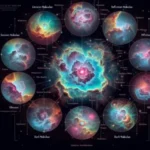
Star formation is not a static event but a violent, multi-million-year physical process. Astronomers do not simply look through telescopes to watch stars appear. They act as cosmic detectives, using high-energy physics and light spectrum analysis to map the collapse of massive gas clouds. If you want to understand this process, think of a molecular cloud as a crowded, chaotic room where gravity eventually forces everyone into a tight huddle.
The Challenge of Interstellar Dust
The primary barrier to observation is dust. Molecular clouds, often called stellar nurseries, are saturated with fine soot and silicate particles. This dust acts like a brick wall against visible light, completely blocking standard optical telescopes. To see inside, astronomers must switch their perspective to longer wavelengths.
Credit : whatcanu.com
Infrared and submillimeter light have longer waves that weave through dust particles instead of bouncing off them. Using the James Webb Space Telescope (JWST) is the modern gold standard here. Its Near-Infrared Camera (NIRCam) functions similarly to how thermal imaging cameras identify heat leaks in a house during winter. It filters out the cold, dark dust to reveal the glowing, warm embryos of stars hidden behind the veil.
Measuring the Collapse with Radio Interferometry
To study the very earliest stages of star formation, optical light is insufficient. Astronomers use the Atacama Large Millimeter/submillimeter Array (ALMA) in Chile. This facility uses a technique called interferometry. It combines data from over 60 individual antennas to act like a single telescope dish with a diameter of up to 16 kilometers.
Why is this necessary? It provides the resolution required to see gas disks orbiting a protostar. These disks are often only a few hundred astronomical units across. Without this level of precision, you would just see a blurred point of light rather than the complex structures where planets begin to accrete. ALMA allows us to measure the velocity of gas moving at speeds of several kilometers per second within these structures.
Analyzing Chemical Fingerprints via Spectroscopy
Credit : whatcanu.com
How do we know the temperature and chemical composition of a protostar that is thousands of light-years away? Astronomers use spectroscopy. This involves splitting the light from a target into a rainbow-like spectrum. Each element—such as carbon, oxygen, or nitrogen—absorbs light at very specific wavelengths, creating unique black lines in the spectrum.
Think of this as a barcode for chemicals. By analyzing these lines, astronomers determine:
The density of the gas core.
The current temperature of the protostar.
The rate at which surrounding material is falling onto the star.
If you see a specific shift in these lines, known as the Doppler shift, you can calculate how fast the gas is swirling inward or being blown outward by stellar winds.
Common Pitfall: Confusing Protostars with Main-Sequence Stars
Credit : whatcanu.com
A frequent error in amateur observation is assuming that a bright infrared source is already a star. A protostar is in a state of gravitational collapse but has not reached the threshold for nuclear fusion. Fusion only occurs when the core temperature hits approximately 10 million degrees Celsius. Below this, the object is merely a ball of gas heating up through compression. Real-time data from NASA’s archives often distinguishes these by looking for ‘outflows’—high-speed jets of gas that only exist during the protostellar phase.
The Feedback Loop: The Life Cycle of Nurseries
Massive stars (those much larger than our Sun) do not just sit there; they dictate the future of their cluster. They emit intense ultraviolet radiation and high-velocity stellar winds. These forces sweep away the remaining gas, effectively shutting down the star-forming factory in their immediate vicinity. This is called stellar feedback. It is a balancing act; while it stops further growth in one area, the shockwaves can compress gas in an adjacent region, triggering a new generation of stars.
Actionable Steps for Data Enthusiasts
If you want to track star formation yourself, you do not need a billion-dollar observatory. You can access professional-grade, open-source data. Start by exploring the MAST (Mikulski Archive for Space Telescopes) portal. Search for data sets related to the ‘Orion Nebula’ or ‘Taurus Molecular Cloud’. These are the most active laboratories for star formation accessible to the public. By analyzing the raw FITS files—the standard image format for astronomers—using software like DS9, you can identify the same protostellar cores that researchers are currently publishing papers on today.