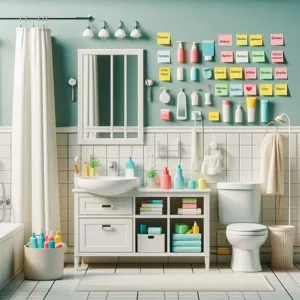
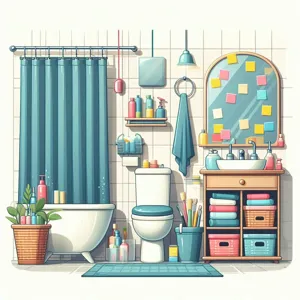
Before buying organizers, map how you use your bathroom. Think of it like a highway interchange: if your daily routine forces you to cross the room to reach a hair dryer, you will inevitably create a traffic jam of clutter. Most people organize based on aesthetics, but you must organize based on proximity.
Empty every drawer. Place items you use within 30 seconds of waking up, such as your toothbrush or daily cleanser, in your primary zone. Reserve deeper storage for items used twice a week or less. If a tool requires you to move another item to reach it, your system is inefficient.
Apply the 50% rule to your inventory
Clutter happens when your storage density exceeds 80%. If your drawers are packed to the brim, you cannot maintain order. Data suggests that in average bathrooms, 30% of stored items are either expired or duplicate backups that remain untouched for over a year.
Follow this strict protocol to prune your inventory:
Check expiration dates: Makeup and skincare products lose chemical stability after 6 to 12 months. Discard them to prevent skin irritation.
Eliminate the ‘backup trap’: Keep only one backup of any essential item. Storing four half-empty shampoo bottles wastes 40% of your available cabinet space.
Categorize by frequency: Sort items into three piles: daily use, weekly use, and seasonal.
Maximize vertical volume, not just floor area
Credit : whatcanu.com
Your bathroom has more surface area than you realize if you look at the walls. Avoid putting everything on the counter, which collects dust and moisture. Use vertical space like a logistics warehouse, where high-frequency items sit at eye level and low-frequency items sit near the floor.
Install tension rods under your sink to create a vertical hanging rail for spray bottles. This simple adjustment can increase your under-sink storage capacity by approximately 40%. Use the inside of cabinet doors for adhesive hooks to hold tools like brushes or hair irons. This removes them from the counter entirely, providing a 100% clear workspace.
The storefront organization method
You should never have to dig for an item. If you cannot identify an object within three seconds, your storage system has failed. Use clear, stackable bins to maintain visibility. Treat your cabinet like a professional retail display: rotate inventory and face labels outward.
Labels are not just for aesthetics; they reduce cognitive load. When you know exactly where the ‘Skincare’ bin is, your brain skips the decision-making process. Use physical tags or a label maker. If a family member can return an item to the correct bin without asking, your organization is successful.
Implement a 120-second daily reset
Credit : whatcanu.com
Organization is a maintenance task, not a singular project. If you leave your bathroom chaotic every night, the entropy will build up by Friday. Set a timer for 120 seconds each evening to perform a reset. Return every item to its labeled bin and wipe down the vanity surface.
Common mistake: Spending hours on a deep clean instead of daily maintenance. If you find the reset takes longer than two minutes, you have too many items. Declutter further until the maintenance time drops back below the two-minute threshold. This is your primary metric for a sustainable system.
Optimize deep storage with modular systems
Deep cabinets are where organization goes to die. Because you cannot see the back, you will naturally pile items in front, burying useful tools forever. Replace static shelves with pull-out drawer inserts. This turns a deep, dark tunnel into a high-visibility, accessible file system.
Use drawer dividers to categorize small items like tweezers or cotton swabs. Without dividers, these items migrate and mix, creating a ‘junk drawer’ effect. Assign every object a specific ‘home’—a fixed coordinate where it must return after use. If an object does not have a home, it is by definition clutter.
Strategic towel and linen management
Credit : whatcanu.com
Bulky linens occupy the most volume in most bathrooms. If your linen closet is overflowing, stop folding towels in traditional squares. Roll them tightly and stack them in a pyramid formation. This reduces the footprint of your towels by nearly 25% while making them easier to grab without toppling the stack.
Keep only one week’s supply of linens in the bathroom. Store extra bedding or overflow towels in a hallway closet. By restricting the volume in your bathroom, you force yourself to rotate clean towels regularly and prevent the accumulation of moisture-trapping excess fabric.
The eco-conscious efficiency shift
Sustainability and organization are linked through reduced consumption. By switching to refillable glass dispensers, you eliminate the visual noise of mismatched plastic branding. This uniformity creates a cleaner, less chaotic visual field.
Minimalism is the ultimate efficiency tool. When you own fewer products, you spend 50% less time cleaning your bathroom and managing inventory. A sparse, curated space functions better and creates a superior environment for your daily morning routine.