How to choose the right window treatments for your living room?

Selecting the right window treatment is a technical decision that impacts your daily comfort, energy bills, and home security. Many homeowners treat windows as mere wall decorations, ignoring the mechanical and environmental variables. This guide provides a professional framework to help you select high-performance solutions for your living space.
Analyze your light and privacy requirements
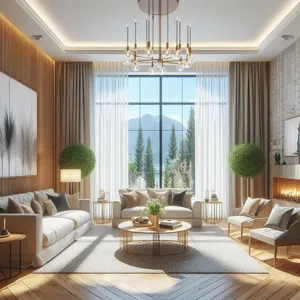
Every window in your living room serves a distinct mechanical purpose. You must prioritize light control based on the orientation of the glass. A south-facing window generates heat gain, while a north-facing window offers consistent, soft light. You are managing a balance between glare, UV damage to upholstery, and personal privacy.
- Solar Control: If you face direct harsh sun, focus on solar shades. These are engineered fabrics that act like a filter, reducing UV intake without blocking the view. Think of them as a pair of high-quality polarized sunglasses for your building.
- Total Blackout Requirements: If your living room doubles as a cinema or an occasional guest space, standard curtains will fail. You need blackout-lined fabrics or cellular shades. These prevent light bleeding at the edges.
- Privacy without darkness: Top-down, bottom-up blinds are currently the industry standard for ground-floor living rooms. They allow you to block the bottom half of the window from street view while keeping the top open for natural light.
Master the mounting geometry
Professional installation is defined by the placement of your hardware. Most amateurs mount rods too close to the frame, which visually shrinks the room. You should aim to expand the perceived scale of your architecture.
- The Ceiling-High Rule: Mount your curtain rod as close to the ceiling as the structural trim allows. This vertical extension creates an optical illusion of higher walls and adds grandeur to any living room.
- Width Expansion: Extend your brackets at least 6 to 10 inches beyond the window frame on each side. When the curtains are drawn back, they should cover the wall, not the glass. This ensures your window opening remains fully exposed to natural light during the day.
- Hardware Integrity: Use heavy-duty wall anchors. Living room curtains, especially velvet or thermal-lined options, are heavier than they look. If your rod sags in the middle, the entire aesthetic loses its clean, professional finish.
Material selection for long-term performance

Avoid aesthetic bias when choosing textiles. Your lifestyle must dictate your fabric choice. A high-traffic living room with pets or children requires different materials than a quiet, low-traffic lounge.
- High-Durability Synthetics: Polyester blends are significantly more resistant to UV degradation than natural cotton or silk. If your window faces the sun, natural fibers will yellow and become brittle within two seasons.
- Cellular Shades for Thermal Efficiency: Cellular, or honeycomb, shades are the most efficient option for insulation. They trap air inside small pockets, acting as an extra layer of glass for your window. This reduces drafts in winter and traps heat outside in summer.
- The Velvet Caution: While velvet provides excellent noise reduction and a luxury feel, it is a dust trap. If you suffer from allergies, avoid heavy, textured fabrics. Opt for smooth, washable synthetic blends instead.
Professional measuring methodology
Do not use a flexible cloth tape measure. These stretch and provide inaccurate data. Use a rigid steel tape measure and record your measurements in millimeters for maximum precision.
- Triangulation: Always measure the width of your window in three places: top, middle, and bottom. Take the narrowest measurement as your master number to ensure blinds fit without binding.
- Floor clearance: For curtains, measure from the rod location to the floor. If you prefer a clean look, your curtains should hover exactly 5 to 10 millimeters above the floor. If you prefer a ‘puddled’ look, add 50 millimeters to the length.
- Stack back space: Account for the space your curtains occupy when bunched against the wall. If your window is near a bookshelf or a door frame, ensure your curtains do not obstruct traffic flow when fully opened.
Current trends and smart integration

The latest trend in living room design is the integration of motorized systems. Battery-operated or hardwired motors now allow you to schedule your window treatments based on the sun’s position. This is not just a luxury; it is a smart energy management tool. You can automatically close shades during the hottest hours of the day to lower your air conditioning costs.
Errors to avoid
Do not ignore the ‘stack back’ ratio. If you buy curtains that are too narrow for your window, they will never look full or elegant. Aim for a fullness ratio of at least 2.5 times the width of the window. If your window is 100cm wide, you need 250cm of fabric width to ensure the pleats look professional when closed. Never skip the swatch test; fabric color changes significantly depending on whether the light is hitting it directly or filtering through it.
Content updated on 2026-10-12