Decoding Towing Capacity: The Math That Keeps You Safe
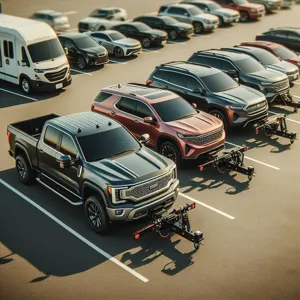
Towing is not a test of your vehicle’s ego. It is a strict application of physics. Before you choose a model, you must understand your limits. Think of towing capacity like the weight limit of a structural bridge; ignore the signage, and you risk a catastrophic collapse of your equipment.
You must balance three specific metrics. First, the Gross Vehicle Weight Rating (GVWR) is the absolute limit your vehicle can weigh with passengers and cargo. Second, the Gross Trailer Weight (GTW) is your trailer fully loaded. Third, the Tongue Weight (TW) is the downward pressure on the hitch. If your tongue weight is too low, your trailer will sway uncontrollably at highway speeds.
The Heavyweights: Evaluating Performance and Real-World Specs
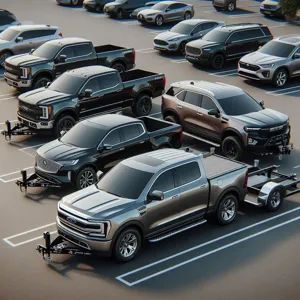
Choosing a tow vehicle requires analyzing torque—the rotational force that gets the load moving—rather than just horsepower. Here is how the top contenders stack up in performance metrics.
1. Ford F-150: The High-Torque Standard
The F-150 with the 3.5-liter EcoBoost V6 generates 500 lb-ft of torque. This is the crucial number for towing, not top speed. Its max towing capacity reaches 14,000 pounds when properly configured. The vehicle uses a high-strength, military-grade aluminum alloy body. This material swap reduces dead weight, allowing for higher payload capacities. Use the Pro Trailer Backup Assist to map your trailer’s dimensions; the system handles steering inputs while you focus on throttle and brake.
2. Chevrolet Silverado 1500: Precision and Camera Tech
The Silverado 1500 is engineered for visibility. It offers a 13.4-inch touchscreen that integrates with eight cameras. Its transparent trailer view creates a digital composite, making the trailer appear invisible on your screen. This is vital for navigating tight turns. Technically, its Duramax 3.0-liter turbo-diesel engine is a standout, providing 495 lb-ft of torque at low RPMs, which is ideal for smooth acceleration with heavy loads.
3. Ram 1500: The Suspension Advantage
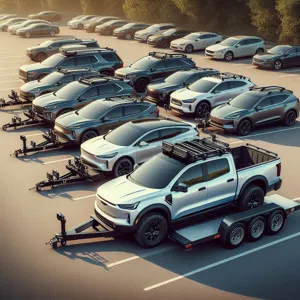
The Ram 1500 utilizes a five-link rear coil-spring suspension. Unlike traditional leaf springs, which can feel harsh, coil springs allow the rear axle to articulate over bumps while maintaining stability. This reduces the ‘porpoising’ effect—the rhythmic bouncing of a trailer. It handles up to 12,750 pounds, but its real value is in how it manages weight distribution across the rear axle during cornering.
4. Toyota Tundra: The Reliability Baseline
The Tundra uses a twin-turbo 3.4-liter V6. Unlike older V8 engines that need high RPMs to build power, this engine delivers peak torque at just 2,400 RPM. This means less engine strain on mountain grades. The i-FORCE MAX hybrid version adds an electric motor between the engine and transmission, providing instant torque that eliminates the lag typical of turbocharged vehicles when pulling away from a stop.
5. Nissan Titan: The Torque-First Approach
The Titan features a 5.6-liter Endurance V8 as standard. It produces 400 horsepower and 413 lb-ft of torque. It is a simpler, more mechanical machine that avoids the over-reliance on complex, gear-hunting software found in other trucks. It is rated for 9,300 pounds. This is the choice for drivers who want a straightforward, reliable workhorse without diving into deep digital configurations.
Technical Pitfalls: Common Mistakes to Avoid

Experience on the road shows that equipment failure is rarely due to the vehicle; it is almost always due to human error. Here are the common failures you must avoid.
- The 10% Tongue Weight Rule: Your tongue weight must be 10% to 15% of the total trailer weight. If you load too much weight behind the trailer axle, the tail wags the dog. This leads to dangerous swaying at speeds over 50 mph.
- Brake Controller Miscalibration: Never rely on your truck’s brakes alone. If you have an electric brake controller, calibrate it for the specific weight of your trailer. Test it by slowing down from 10 mph using only the manual controller lever. If it locks the trailer wheels, dial it down.
- Ignoring Thermal Management: Towing generates intense heat in your transmission. Always engage ‘Tow/Haul’ mode. This setting delays upshifts to keep the engine in its optimal power band and firms up transmission shifts to prevent clutch slip.
Making Your Final Decision
Before purchasing, look at your trailer’s ‘Gross Vehicle Weight Rating’ sticker. Do not use the ‘dry weight’ of a trailer, as this excludes water, propane, and your gear. Always ensure your vehicle’s tow rating exceeds your fully loaded trailer weight by at least 20%. This safety buffer ensures you aren’t running your engine at its absolute limit, which extends the lifespan of your transmission and cooling system.
If you tow infrequently, an SUV like the Jeep Grand Cherokee (7,200 lbs capacity) offers the necessary muscle without the bulk of a pickup. For full-time hauling, stick to the F-150 or Silverado platforms. Prioritize a vehicle with an integrated trailer brake controller; aftermarket additions are often less responsive and less reliable than factory-installed systems.
Content updated on 2026-09-11